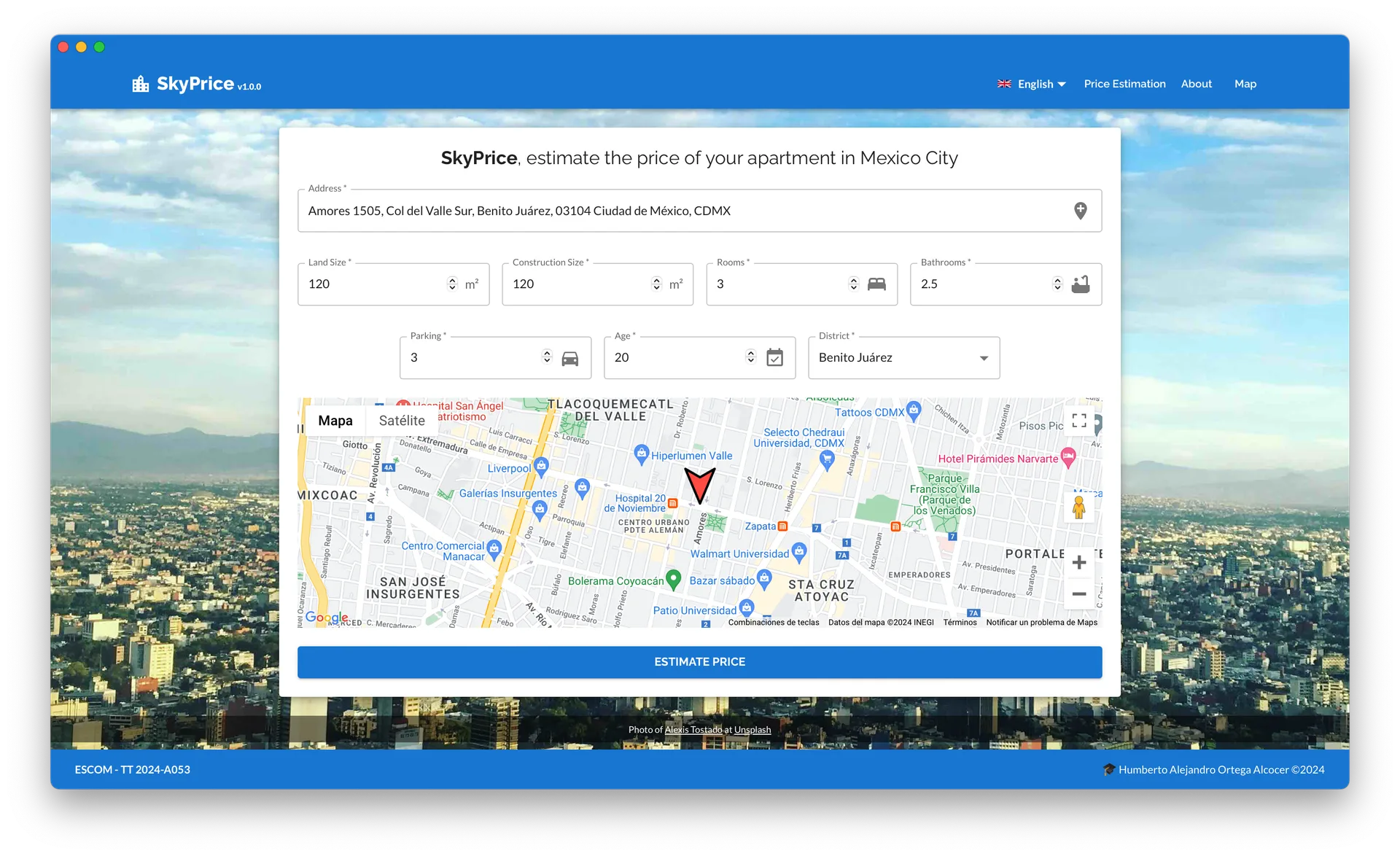
SkyPrice was my thesis project at ESCOM–IPN. It explores estimating an apartment’s asking price in Mexico City from its characteristics and location. The work spans data preparation, training, evaluation and an application for requesting predictions.
The apartment and its surroundings#
Listings supply asking prices and property characteristics. The project incorporates geographic context, including service locations, postal codes and other city datasets. Preparation brings these sources into variables the models can use.
KeplerGL visualizations help inspect the spatial distribution of the data. They reveal where information is available and which coverage differences might remain hidden in a table.
Comparing models against the same question#
Training compares Random Forest, support vector machines and neural networks. The code uses scikit-learn and TensorFlow, with preprocessing, hyperparameter search and separate training and test data.
Evaluation considers MAE, RMSE and R², exposing different aspects of error. A single number does not explain which properties or neighborhoods a model handles better. The project’s results belong to the dataset and evaluation procedure documented in the thesis.
Bringing the calculation into an application#
A FastAPI service loads models and receives the inputs needed for estimates. The interface collects location and property characteristics; a Telegram bot explores a conversational route for requesting information.
The work is divided into backend, interface, bot and thesis document. This makes both the modeling experiment and its supporting application components inspectable.
Interpreting the result#
The target is an asking price observed in listings. It is not a completed transaction price or an appraisal. Usefulness depends on data coverage, quality and period as well as the algorithm. The thesis and article collect the procedure and its limits.